Prevention Is a Legal Requirement
Federal and state regulations require healthcare facilities to prevent bedsores whenever possible. The Centers for Medicare & Medicaid Services (CMS) explicitly states that facilities must ensure residents do not develop pressure ulcers unless clinically unavoidable. This is not a suggestion—it is a regulatory mandate.
When bedsores develop in a healthcare setting, regulators and courts look at whether the facility followed established prevention protocols. Failure to implement these standards is considered a deficiency in care and may constitute negligence.
AHRQ Prevention Bundles
The Agency for Healthcare Research and Quality (AHRQ) developed comprehensive prevention bundles—coordinated sets of interventions that, when implemented together, significantly reduce pressure injury rates. These bundles represent the standard of care that facilities are expected to follow.
The AHRQ prevention bundle includes five core components that must work together:
- Comprehensive skin assessment: Regular inspection of all skin, with particular attention to bony prominences
- Standardized risk assessment: Using validated tools to identify at-risk patients
- Repositioning and mobility: Regular position changes and early mobilization
- Nutrition optimization: Ensuring adequate protein, calories, and hydration
- Moisture management: Keeping skin dry and managing incontinence
Research shows that facilities implementing these bundles consistently achieve significant reductions in pressure injury rates. The evidence is clear: these interventions work when properly implemented.
Risk Assessment Requirements
Every patient entering a healthcare facility should be assessed for pressure injury risk using a validated assessment tool. The most widely used tool is the Braden Scale, which evaluates six risk factors:
- Sensory perception: Ability to respond meaningfully to pressure-related discomfort
- Moisture: Degree to which skin is exposed to moisture
- Activity: Degree of physical activity
- Mobility: Ability to change and control body position
- Nutrition: Usual food intake pattern
- Friction and shear: Level of friction and shear forces on skin
When Risk Assessments Must Occur
Risk assessments are required at specific intervals:
- Upon admission to the facility
- With any significant change in condition
- On a regular schedule (typically weekly in long-term care, daily in intensive care)
- After any procedure involving anesthesia or sedation
- When new pressure injuries are identified
A patient's risk level determines the intensity of prevention interventions required. High-risk patients require more frequent repositioning, specialized support surfaces, and closer monitoring.
Comprehensive Skin Inspection
Regular skin inspection is essential for both prevention and early detection. Facilities must conduct thorough skin assessments that include:
- Inspection of all skin surfaces, with special attention to bony prominences
- Assessment of skin color, temperature, moisture, and integrity
- Documentation of any redness, discoloration, or changes in skin condition
- Evaluation of tissue tolerance to pressure (blanching versus non-blanching erythema)
Skin inspections should occur at least daily for at-risk patients, and more frequently for high-risk individuals. Any changes must be documented and acted upon immediately.
Repositioning and Mobility Protocols
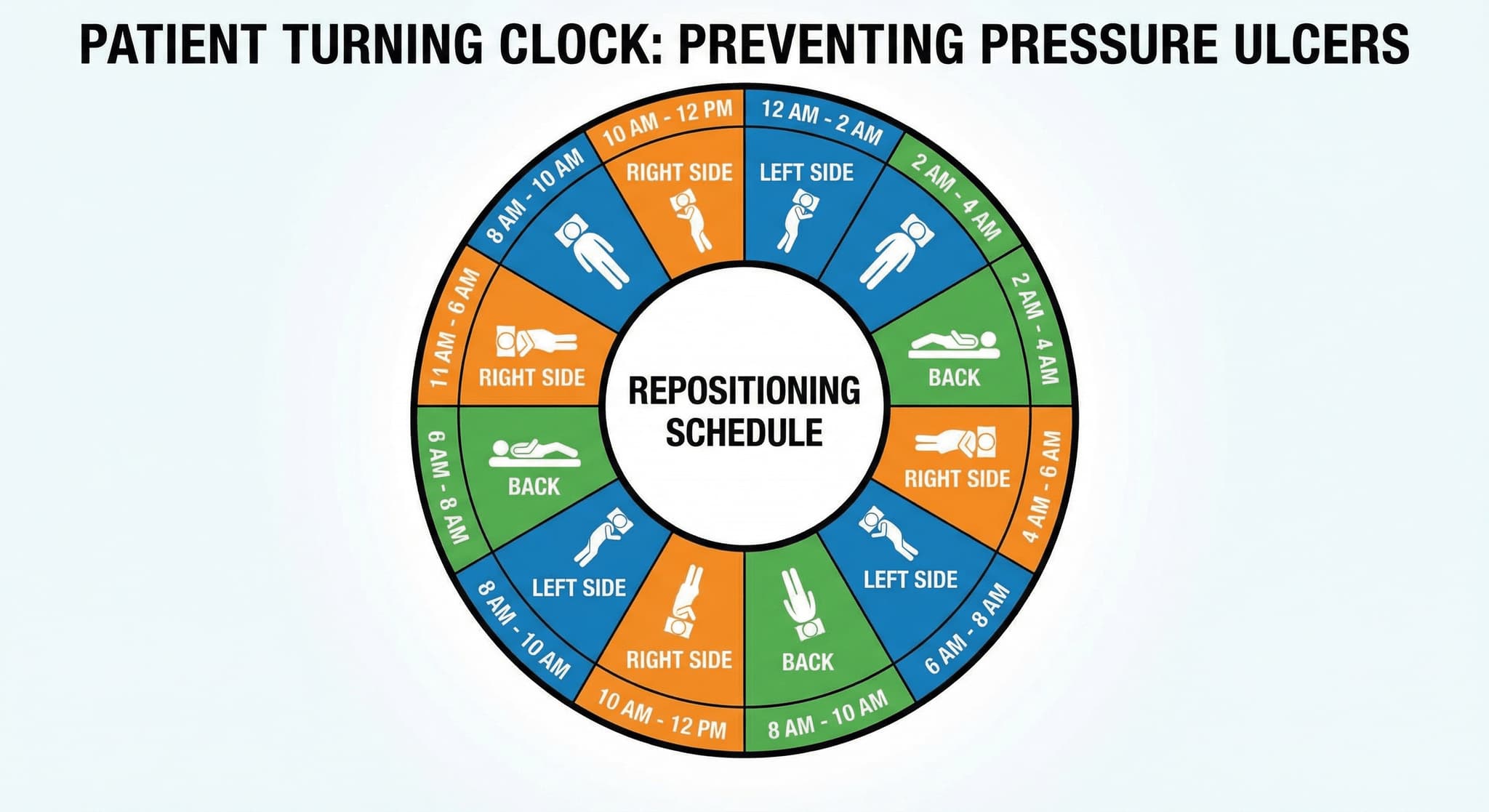
Regular repositioning is the cornerstone of pressure injury prevention. When patients cannot reposition themselves, staff must do it for them on a scheduled basis.
Standard Repositioning Requirements
- Bed-bound patients: Repositioned at least every 2 hours, around the clock
- Wheelchair users: Weight shifts every 15-30 minutes, with periodic return to bed
- High-risk patients: May require more frequent repositioning based on individual assessment
- Post-operative patients: Repositioning as soon as medically appropriate
Proper Repositioning Techniques
Repositioning must be done correctly to be effective:
- Use lift sheets and proper transfer equipment to avoid friction and shear
- Position at 30-degree lateral angles rather than flat on the side
- Use pillows or foam wedges to maintain positions and protect bony prominences
- Keep the head of the bed at the lowest elevation consistent with medical needs
- Float heels off the bed surface using pillows under the calves
- Never position patients directly on existing pressure injuries
Documentation of repositioning is critical. Facilities should maintain turning schedules with recorded times and positions. Missing or incomplete documentation often indicates that repositioning was not performed as required.
Support Surfaces and Equipment
Appropriate support surfaces help redistribute pressure and reduce tissue damage. The selection of support surfaces should be based on individual patient risk and needs:
- High-specification foam mattresses: Minimum standard for at-risk patients
- Alternating pressure mattresses: For higher-risk patients or those with existing injuries
- Low air loss surfaces: For high-risk patients and wound healing support
- Pressure-redistributing wheelchair cushions: For patients spending extended time in wheelchairs
- Heel protection devices: To float heels and eliminate pressure
Standard hospital mattresses are not adequate for at-risk patients. Facilities must have appropriate support surfaces available and must match the surface to patient needs.
Nutrition and Hydration Management
Adequate nutrition is essential for maintaining skin integrity and supporting tissue healing. Facilities must assess nutritional status and provide appropriate interventions:
Nutritional Assessment
- Screen for malnutrition upon admission and regularly thereafter
- Monitor weight and document unintended weight loss
- Assess ability to eat independently and provide assistance as needed
- Evaluate laboratory markers of nutritional status when appropriate
- Consult dietitians for at-risk patients
Nutritional Interventions
- Protein: Ensure adequate protein intake (typically 1.25-1.5 g/kg body weight for at-risk patients)
- Calories: Provide sufficient calories to maintain weight and support healing
- Hydration: Maintain adequate fluid intake unless medically contraindicated
- Supplements: Consider protein supplements, multivitamins, and micronutrient supplementation when dietary intake is inadequate
Allowing a patient to become malnourished in a healthcare facility represents a fundamental failure of care. Weight loss and declining nutritional status should trigger immediate intervention.
Moisture Management and Skin Care
Moisture damages skin and increases susceptibility to pressure injuries. Facilities must implement effective moisture management:
- Incontinence care: Prompt cleansing and barrier cream application after incontinence episodes
- Absorbent products: Use of appropriate incontinence products that wick moisture away from skin
- Perspiration management: Moisture-wicking fabrics and temperature control
- Wound drainage: Proper management of drainage from wounds or tubes
- Skin cleansing: Gentle cleansing with pH-balanced products
- Moisturization: Application of moisturizers to dry skin, avoiding areas at high risk for breakdown
Patients should never be left in wet or soiled linens. Timely incontinence care is a basic requirement of nursing care.
Documentation Requirements
Proper documentation serves multiple purposes: it guides care, ensures continuity, and provides evidence of whether prevention protocols were followed. Required documentation includes:
- Risk assessment scores and dates
- Skin inspection findings
- Repositioning schedules and completion records
- Support surface selection and rationale
- Nutritional assessments and interventions
- Care plan goals and interventions for at-risk patients
- Any new skin findings and response actions
Missing or falsified documentation is a serious concern. When reviewing cases, attorneys and experts look for gaps in documentation that suggest care was not actually provided.
Staff Training and Competency
Prevention protocols are only effective when staff are properly trained and competent to implement them. Facilities must:
- Provide initial training on pressure injury prevention for all nursing staff
- Conduct ongoing education and competency assessments
- Ensure adequate staffing levels to perform required interventions
- Hold staff accountable for following prevention protocols
- Investigate and address any breakdowns in care processes
Understaffing is never an acceptable excuse for failing to provide required care. Facilities are responsible for maintaining adequate staff to meet patient needs.
When Prevention Standards Are Not Met
When bedsores develop in a healthcare setting, it often indicates that one or more of these prevention standards was not followed. Common failures include:
- Failure to conduct or document risk assessments
- Inadequate or inconsistent repositioning
- Use of inappropriate support surfaces
- Delayed response to incontinence
- Failure to address nutritional decline
- Inadequate skin inspections or failure to act on findings
- Insufficient staffing to provide required care
- Poor documentation or falsified records
These failures can be identified through medical record review and professional analysis. They form the basis for negligence claims against facilities that did not meet the standard of care.
Holding Facilities Accountable
When healthcare facilities fail to implement required prevention standards and patients develop bedsores as a result, families have legal options. Facilities may be held liable for:
- Nursing home neglect when care standards are not met
- Hospital negligence during acute care stays
- Violations of residents' rights under federal and state law
- Corporate liability for systemic understaffing or policy failures
Medical records, staffing schedules, and facility policies can reveal whether prevention standards were followed. An experienced attorney can help families understand what happened and whether legal action is appropriate.
When to Seek Legal Help
Consider consulting with an attorney if:
- Your loved one developed bedsores while in a healthcare facility
- Existing bedsores worsened under the facility's care
- You observed inadequate care (infrequent turning, wet linens, poor hygiene)
- Bedsores led to complications such as infection, sepsis, or hospitalization
- The facility did not inform you promptly about the injury
- Documentation appears incomplete, inconsistent, or falsified
At Traction Law Group, we review medical records with healthcare experts to determine whether prevention standards were met. Contact us for a free consultation to discuss your situation.
Additional Resources
Learn more about bedsore prevention and legal options:
- Understanding the Causes of Bedsores – What causes pressure injuries and why they are preventable
- Pressure Ulcer Stages – How bedsores are classified and progress
- What To Do If Your Loved One Has Bedsores – Immediate steps for concerned families
- Questions to Ask Nursing Homes About Bedsores – How to vet a facility's prevention practices
- Bedsore Lawsuits – Understanding your legal options