What Is an Unstageable Pressure Injury?
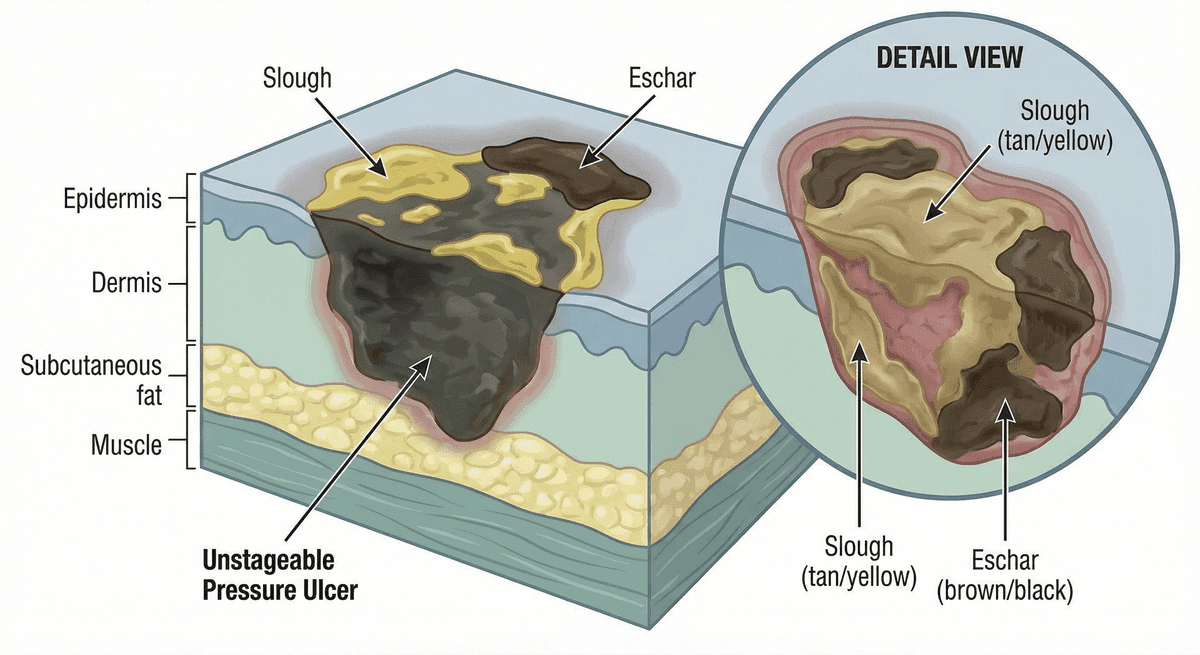
The National Pressure Injury Advisory Panel (NPIAP) defines an unstageable pressure injury as a full thickness tissue loss in which the base of the wound is covered by slough or eschar in the wound bed. The key characteristic is that the true depth of tissue damage cannot be determined without removing the obscuring tissue.
The wound bed can be covered by either slough or eschar. These are two different types of dead tissue, described in detail below. Both prevent an accurate assessment of how deep the wound extends.
Unlike Stages 1-4 where the wound depth can be visualized and measured, unstageable wounds require debridement (removal of dead tissue) before their true severity can be determined. Once the slough or eschar is removed, the wound is then reclassified as Stage 3 or Stage 4 based on the depth of tissue loss revealed.
Staging any pressure injury depends on being able to see how deep the damage goes: from Stage 1's intact skin to Stage 4's exposed bone or muscle. When slough or eschar covers the wound bed, clinicians cannot visualize that depth. So the wound is classified as "unstageable" rather than assigned a numbered stage.
This is a placeholder classification, not a lesser severity. An unstageable wound is, by definition, already a full thickness wound, and it cannot be downgraded to Stage 1 or Stage 2 once slough or eschar is present.
Eschar vs. Slough: What They Look Like
Slough and eschar are both types of dead tissue that can cover a wound bed, but they look and feel different:
Slough
Slough is soft, moist, dead tissue. It can appear yellow, tan, gray, green, or brown, and it may look stringy or mucus-like, loosely or firmly attached to the wound bed.
Eschar
Eschar is dry, thick, and leathery dead tissue. It is typically tan, brown, or black. It is usually firmly attached to the wound, often resembling a hard scab or crust that covers the underlying damage.
| Feature | Slough | Eschar |
|---|---|---|
| Texture | Soft, moist, sometimes stringy or mucus-like | Dry, thick, and leathery, like a hard scab |
| Color | Yellow, tan, gray, green, or brown | Tan, brown, or black |
| Attachment | Loosely or firmly attached to the wound bed | Firmly attached, often covering the entire wound |
| What It Means | Obscures the wound bed and typically must be removed before the wound can be accurately staged | Obscures the wound bed; stable, dry eschar on the heel without signs of infection may be an exception (see below) |
Why Wounds Become Unstageable
Understanding why a wound becomes unstageable helps explain why these wounds often indicate care failures:
Natural Wound Progression
When tissue dies due to prolonged pressure, the body attempts to wall off the damaged area. Dead tissue accumulates in the wound bed as the injury progresses. Without proper wound care intervention, this dead tissue builds up and obscures the wound.
Inadequate Wound Care
Proper wound management includes regular debridement—removing dead tissue to promote healing and allow accurate wound assessment. When healthcare providers fail to perform or arrange for appropriate debridement, wounds accumulate slough and eschar that hides the true extent of damage. Understanding the bedsore prevention standards that facilities must follow can help families identify care failures.
Delayed Treatment
Wounds that are not identified early and treated promptly are more likely to develop significant dead tissue. The presence of an unstageable wound often suggests that earlier intervention was missed or delayed.
Lack of Proper Assessment
Healthcare facilities are required to regularly assess wounds and document their progression. When wounds become obscured by dead tissue, it may indicate that assessments were not being performed with sufficient frequency or expertise.
What's Usually Underneath an Unstageable Wound
An unstageable classification means the wound bed cannot be seen, so families often want to know what the label actually implies about severity. By definition, an unstageable pressure injury already involves full thickness tissue loss: skin and underlying tissue have been destroyed. The slough or eschar simply prevents anyone from confirming, without debridement, whether that loss extends:
- to fat tissue (consistent with a Stage 3 injury), or
- all the way to muscle, tendon, or bone (consistent with a Stage 4 injury).
In practice, once an unstageable wound is debrided and the wound bed becomes visible, it is typically reclassified as Stage 3 or Stage 4.
Families and caregivers should treat an unstageable wound with the same urgency as a Stage 3 or Stage 4 injury. Do not assume it is less severe simply because it has not yet been assigned a number.
What Can an Unstageable Wound Hide?
The most concerning aspect of unstageable pressure injuries is what lies beneath the surface:
Unknown Depth
The slough or eschar covering an unstageable wound can hide extensive tissue destruction. What appears to be a relatively contained wound may, once debrided, reveal a deep crater extending to muscle, tendon, or bone—a Stage 4 injury.
Undermining and Tunneling
Unstageable wounds frequently have undermining (tissue destruction beneath intact skin edges) and tunneling (channels extending from the wound into surrounding tissue). These hidden extensions of the wound cannot be seen until the wound is properly debrided and examined.
Active Infection
Dead tissue provides an ideal environment for bacterial growth. Slough and eschar can harbor serious infections, including antibiotic-resistant organisms like MRSA. The infection may be spreading beneath the surface without visible signs.
Bone Involvement
When unstageable wounds are located over bony prominences (sacrum, heels, hips), there is a significant risk that the wound extends to the bone. Osteomyelitis (bone infection) may already be present but undetectable until the wound is properly assessed.
How Clinicians Approach Unstageable Wounds
Unstageable pressure injuries require specialized medical management and carry significant health risks. The information below is educational and general in nature. The specific assessment and treatment plan for any wound is a clinical decision made by the treating physician or wound care team based on the individual patient.
Assessment
Clinicians typically document the wound's location, size, surrounding skin condition, and any signs of infection. They then reassess it on a regular basis to track whether it is stable, improving, or worsening. The wound bed cannot be fully evaluated while it is covered by slough or eschar. So the treating team must also decide whether and when debridement is appropriate for that patient.
Debridement as a Clinical Decision
Most unstageable wounds require debridement, removal of the dead tissue covering the wound bed, before they can be accurately staged and treated. Debridement methods include:
- Sharp/surgical debridement: Cutting away dead tissue with a scalpel or scissors (fastest but requires trained clinician)
- Enzymatic debridement: Using topical enzymes to break down dead tissue (slower but less invasive)
- Autolytic debridement: Using the body's own enzymes with moisture-retentive dressings (slowest method)
- Mechanical debridement: Physical removal using wet-to-dry dressings or wound irrigation
Exception: Stable Heel Eschar
The one exception to routine debridement is stable, dry eschar on the heel without signs of infection (redness, warmth, drainage, odor). In this specific case, the eschar may serve as a natural biological cover and is often left intact. However, this requires careful monitoring and should not be used as an excuse to avoid proper wound assessment elsewhere on the body.
Treatment Challenges
Once debrided, unstageable wounds often reveal extensive damage requiring aggressive treatment:
- Extended antibiotic therapy if infection is present
- Negative pressure wound therapy (wound VAC)
- Specialized dressings and wound care
- Potential surgery for wound closure or tissue repair
- Management of underlying conditions affecting healing
Prolonged Healing
Because unstageable wounds typically conceal Stage 3 or Stage 4 injuries, healing times are measured in months to years. Some wounds may never fully heal, leaving patients with chronic, draining wounds requiring ongoing care for the rest of their lives.
Is an Unstageable Bedsore a Sign of Neglect?
Not automatically, but it is a serious warning sign that warrants a closer look. For a wound to accumulate enough dead tissue to become unstageable, there is usually a gap somewhere in prevention, early detection, or ongoing wound care, rather than a single missed step. In a well-run facility, pressure injuries are identified early, documented, and treated before they progress this far. Wounds that do develop are regularly reassessed and debrided as clinically appropriate.
That said, not every unstageable wound results from neglect. Some patients have medical conditions or circulation problems that make wounds especially difficult to prevent or heal even with excellent care. Determining whether negligence contributed to a specific wound requires reviewing the medical records, care plans, and staffing history for that patient. The Legal Considerations section below explains what that review typically looks for.
Legal Considerations
The presence of an unstageable pressure injury in a nursing home or hospital patient raises serious questions about the quality of care provided:
Evidence of Neglect
For a wound to accumulate enough dead tissue to become unstageable, there usually have been gaps in prevention, early detection, or ongoing wound care:
- Failure to prevent the wound from developing initially
- Failure to identify the wound at an early stage
- Failure to provide appropriate treatment as the wound progressed
- Failure to perform or arrange for timely debridement
- Failure to accurately assess and document wound status
Regulatory Violations
Nursing homes receiving Medicare or Medicaid funding must comply with federal regulations requiring facilities to ensure residents receive necessary treatment and services to heal pressure ulcers and prevent new ones from developing. An unstageable wound may indicate violations of these requirements.
Documentation Concerns
When wounds are described as "unstageable," it's important to investigate whether this classification is accurate or being used to minimize the apparent severity of a wound in facility records. Complete medical records should include:
- Initial wound assessment with measurements and photos
- Regular reassessments documenting progression
- Wound care treatments provided
- Debridement procedures and findings
- Re-staging once the wound bed is visible
Facility Liability
Healthcare facilities may be held liable for unstageable pressure injuries when they result from inadequate prevention, delayed treatment, or failure to provide appropriate wound care. Compensation may include:
- Medical expenses for treatment and ongoing care
- Pain and suffering
- Disfigurement and scarring
- Reduced quality of life
- Wrongful death damages if complications prove fatal
What Warning Signs Should Families Watch For?
Family members should be alert to signs that a loved one may have an unstageable or developing pressure injury:
- Dark, discolored areas on the skin that don't blanch
- Black, brown, or tan hard areas of skin (eschar)
- Yellow, tan, or greenish soft tissue in wounds (slough)
- Wounds that seem to be getting worse despite treatment
- Foul odor from wounds or bandaged areas
- Fever or other signs of infection
- Staff being vague about wound descriptions or staging
- Reluctance to show you wounds during visits
How to Document an Unstageable Wound
If you discover your loved one has an unstageable pressure injury, documentation is crucial for any potential legal action:
- Request photographs of the wound from the facility or take photos if permitted, with dates and measurements visible
- Obtain complete medical records including wound care logs, nursing assessments, and physician orders
- Document the timeline of when the wound was first noted vs. when you were informed
- Ask specific questions about whether debridement has been performed and what was found beneath the dead tissue
- Request the re-staging once the wound is debrided and the true depth can be assessed
- Note any signs of infection including fever, redness around the wound, drainage, or foul odor
- Keep a journal of your observations during each visit, including staff responses to your questions. See our bedsore documentation guide for detailed steps
When Should You Talk to a Bedsore Lawyer?
You should consult a bedsore attorney if your loved one has developed an unstageable pressure injury in a care facility and:
- The wound developed after admission to the facility
- You were not promptly informed about the wound
- The facility seems reluctant to debride the wound or provide details
- Once debrided, the wound reveals Stage 3 or Stage 4 damage
- Your loved one has developed signs of infection or sepsis
- You have concerns about staffing levels or care quality
- Multiple wounds or rapidly progressing wounds are present
At Traction Law Group, we understand that unstageable pressure injuries often hide the true extent of neglect and suffering. We help families investigate how these wounds developed, uncover the hidden severity beneath the surface, and hold negligent facilities accountable.
Debridement permanently changes the wound, so the records and photographs taken beforehand are often the clearest evidence of what your loved one endured. Learn how a bedsore lawyer can help. Contact our team for a free consultation. There is no fee unless there is a recovery.
Frequently Asked Questions
- What is an unstageable pressure injury?
An unstageable pressure injury is a wound where the full extent of tissue damage cannot be determined because the wound bed is covered by slough (yellow, tan, or brown dead tissue) or eschar (dry, black, leathery dead tissue). Once the dead tissue is removed through debridement, the wound is typically reclassified as Stage 3 or Stage 4 based on the depth of damage revealed.
- Why is an unstageable bedsore dangerous?
Unstageable wounds are dangerous because they hide the true severity of tissue damage. What appears to be a contained wound may conceal deep destruction extending to muscle or bone.
The dead tissue covering the wound also harbors bacteria, increasing the risk of serious infection, sepsis, and osteomyelitis. According to NPIAP guidelines, most unstageable wounds require debridement to allow proper assessment and healing.
- Can an unstageable wound indicate nursing home neglect?
Often, yes. For a wound to accumulate enough dead tissue to become unstageable, there usually have been gaps in prevention, early detection, or ongoing wound care over an extended period, though not every unstageable wound is the result of neglect.
Proper wound management includes regular debridement to remove dead tissue. The presence of an unstageable wound often indicates that the facility failed to follow accepted wound care standards established by AHRQ and CMS.
- What happens when an unstageable wound is debrided?
When dead tissue is removed from an unstageable wound through debridement, the true depth and severity of the injury are revealed. Most unstageable wounds are reclassified as Stage 3 (fat tissue visible) or Stage 4 (bone, tendon, or muscle exposed) after debridement.
The exception is stable, dry eschar on the heel without signs of infection, which may be left intact as a natural biological cover.
- Should I contact a lawyer about an unstageable bedsore?
If your loved one developed an unstageable pressure injury in a nursing home or hospital, consulting a bedsore attorney is recommended. Unstageable wounds suggest prolonged inadequate care.
Traction Law Group works with co-counsel attorneys across the country to help families investigate these cases, and consultations are free with no fee unless there is a recovery.
- What's the difference between eschar and slough?
Slough is soft, moist dead tissue that can appear yellow, tan, gray, green, or brown, and may look stringy or mucus-like. Eschar is dry, thick, and leathery dead tissue, typically tan, brown, or black, and is firmly attached to the wound like a hard scab.
Both types of tissue cover the wound bed and generally must be addressed before the true depth of an unstageable wound can be determined.
- Is an unstageable pressure injury the same as Stage 4?
Not exactly, though the two are closely related. An unstageable wound already involves full thickness tissue loss, but its exact depth is unknown until the slough or eschar covering it is removed.
Once debrided, many unstageable wounds are reclassified as Stage 4 (exposed bone, tendon, or muscle), while others are reclassified as Stage 3 (visible fat tissue, no exposed bone or muscle). Until debridement occurs, the wound is correctly described as unstageable rather than Stage 3 or Stage 4.
- How is an unstageable wound assessed if it can't be staged?
Even though an unstageable wound cannot be assigned a numbered stage until it is debrided, clinicians still assess and document its size, location, surrounding skin condition, drainage, odor, and signs of infection at each evaluation. This ongoing assessment, along with the clinical decision about if and when to debride, helps guide treatment even before the wound's exact depth is confirmed.